


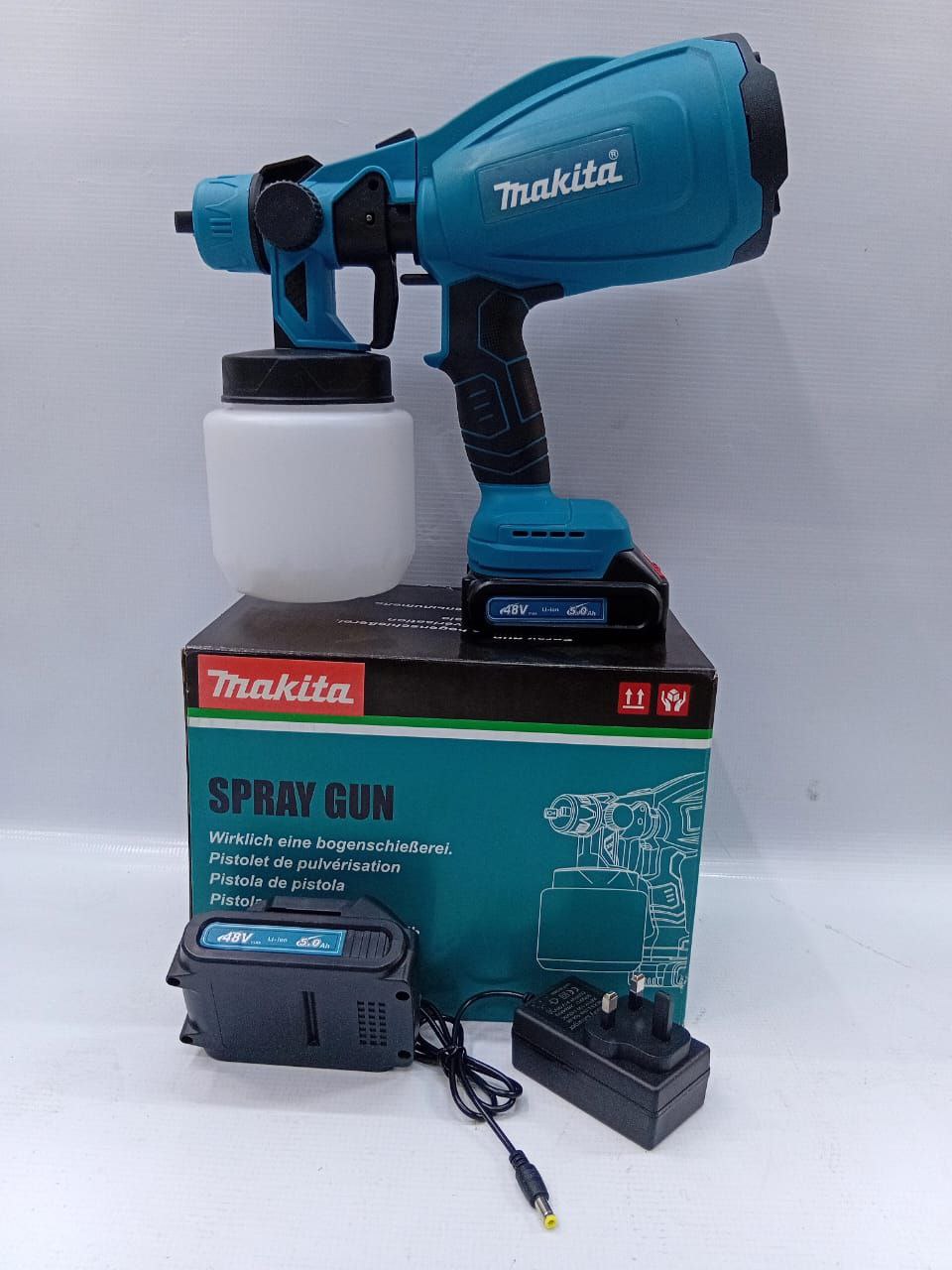

Makita cordless spray gun
KSh6,500.00
A cordless spray gun is a battery-powered tool designed for applying paint, stain, varnish, or other liquid coatings. It offers the freedom of movement and convenience of a cordless tool, eliminating the need for a power cord or a separate air compressor. This makes it an ideal choice for a variety of tasks, from small touch-ups to painting furniture, fences, and walls.
Types of Cordless Spray Guns
Cordless spray guns primarily fall into two categories based on their atomization method:
- High-Volume, Low-Pressure (HVLP) Sprayers:
- How it works: These use a motor-driven turbine to produce a high volume of air at a low pressure to atomize the paint. The paint is typically held in a cup attached to the gun.
- Best for: Fine-finish work on smaller projects like furniture, cabinets, doors, and trim. They are known for providing a smooth, professional finish with minimal overspray.
- Pros: Excellent for detailed work, good control, and less paint waste.
- Cons: May require thinning of the paint to the correct viscosity to avoid clogging. Not ideal for very large-scale projects.
- Airless Sprayers:
- How it works: These use a high-pressure pump (powered by the battery) to force unthinned paint through a small tip, which atomizes it.
- Best for: Larger projects where speed is more important than fine detail, such as painting walls, fences, or exterior siding.
A cordless spray gun is a battery-powered tool designed for applying paint, stain, varnish, or other liquid coatings. It offers the freedom of movement and convenience of a cordless tool, eliminating the need for a power cord or a separate air compressor. This makes it an ideal choice for a variety of tasks, from small touch-ups to painting furniture, fences, and walls.
Types of Cordless Spray Guns
Cordless spray guns primarily fall into two categories based on their atomization method:
- High-Volume, Low-Pressure (HVLP) Sprayers:
- How it works: These use a motor-driven turbine to produce a high volume of air at a low pressure to atomize the paint. The paint is typically held in a cup attached to the gun.
- Best for: Fine-finish work on smaller projects like furniture, cabinets, doors, and trim. They are known for providing a smooth, professional finish with minimal overspray.
- Pros: Excellent for detailed work, good control, and less paint waste.
- Cons: May require thinning of the paint to the correct viscosity to avoid clogging. Not ideal for very large-scale projects.
- Airless Sprayers:
- How it works: These use a high-pressure pump (powered by the battery) to force unthinned paint through a small tip, which atomizes it.
- Best for: Larger projects where speed is more important than fine detail, such as painting walls, fences, or exterior siding.
| Weight | 3 lbs |
|---|
Related products

Air brad nailer combo 2 IN 1
KSh8,350.00

Air compressor
KSh16,350.00

Auto air compressor
KSh7,350.00
Auto air compressor
KSh8,250.00
Belt sander
KSh19,750.00

Cordless sheet sander
KSh9,450.00

Drill press
KSh29,850.00
Electric planer
KSh9,350.00

Lithium-ion cordless brad nailer
KSh24,850.00

Lithium-ion grass trimmer
KSh13,550.00
Rotary sander
KSh7,950.00
Reviews
There are no reviews yet.